Rebuilding after head and neck surgery
When removing a cancer from the mouth or the neck leaves a gap, tissue from your own body is moved to fill it, in the same operation.
What it is
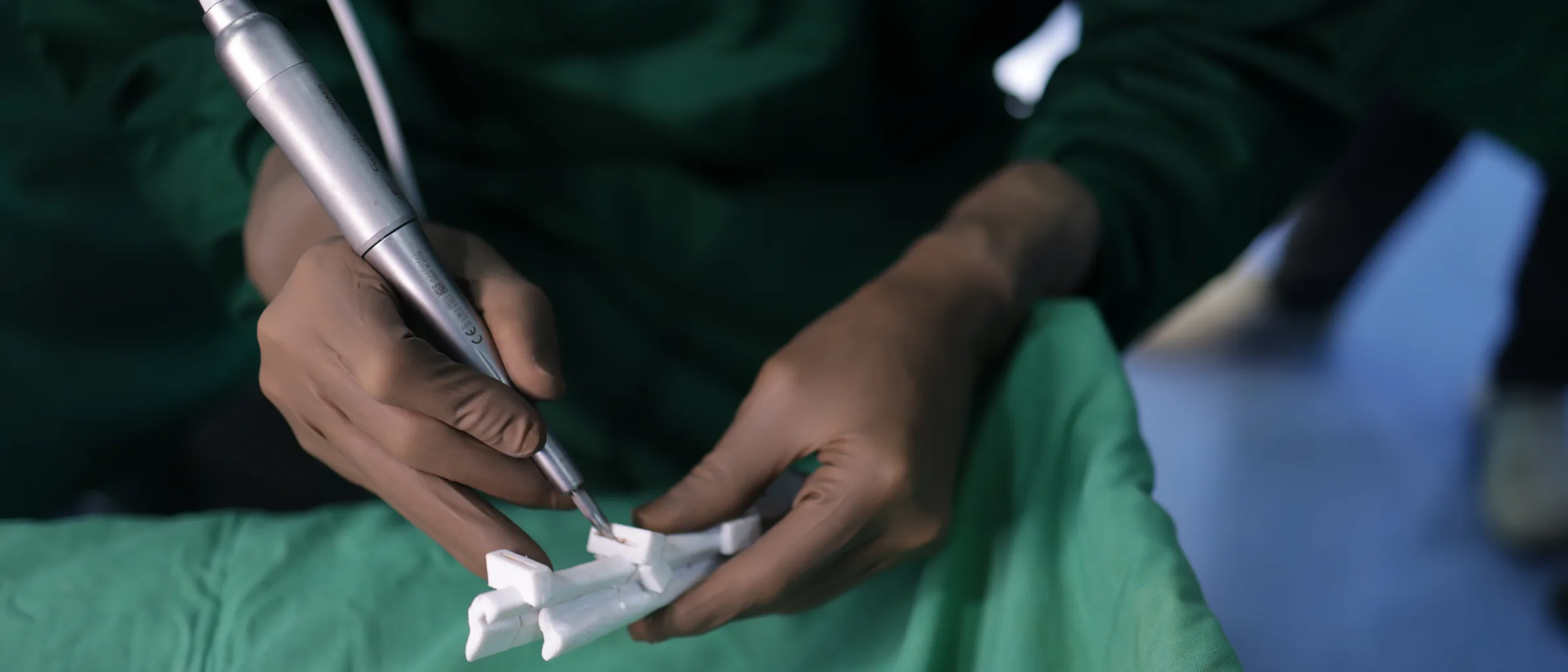
Surgery for a cancer in the mouth, the tongue, the jaw or the throat has to take a margin of healthy tissue along with the tumour, and that leaves a gap. Pulling the edges of a gap that size together would make the mouth smaller, tether the tongue and change speech and swallowing permanently, so the gap is filled instead — with tissue taken from somewhere else on your own body. A piece of skin with the fat beneath it is lifted from the forearm or the thigh; where the jaw has to be rebuilt, a length of bone with skin attached is taken from the lower leg. What makes it a free flap is that the piece is separated completely, its own artery and vein included, and carried up to the neck as a thing on its own. There it is set into the gap, and the artery and vein that travelled with it are joined to an artery and a vein in the neck using stitches finer than a hair, under high magnification. That joining is the microvascular part, and the whole operation turns on it: once blood flows into the flap and drains out of it again, the tissue is alive in its new place and it goes on living there. This is not a transplant from another person. Every part of it is yours, so rejection is not a question that arises and there is no medicine to take to prevent it. The rebuilding is planned before the day, alongside the cancer operation, and both happen in one sitting — the cancer is not removed on one day and the rebuilding left for months later.
What happens, step by step
- Before the day: the planning that decides most of it.
Scans are looked at again to work out how much has to be removed and therefore how much has to be replaced. A dentist checks your teeth, and any that are beyond saving are taken out before the operation rather than after it, because a tooth that gives trouble later is much harder to deal with in rebuilt tissue. Blood tests, a chest check and a heart check say whether a long anaesthetic is safe for you. If the forearm is being considered, a simple bedside test on your wrist checks that the hand has a good blood supply from its second artery, because one of them is going to travel with the flap. You meet the speech and swallowing therapist and a dietitian before anything is done, not afterwards. If you use tobacco or alcohol, stopping now genuinely changes how well tissue heals, and the team will help you do it.
- Choosing where the tissue comes from, with you in the room.
Each donor site costs something different, and you are entitled to know what before you consent. The forearm gives thin, soft skin that folds well inside a mouth, and it leaves a patch on the arm that is covered with a thin skin graft taken from the thigh — a scar on the forearm that is visible when sleeves are short. The thigh gives thicker tissue and a scar that clothes cover. The lower leg gives bone for a jaw, and you work with a physiotherapist to get walking again afterwards. Your surgeon will say which sites are suitable for your operation and why one is preferred; ask what the arm or the leg will look like and what it will and will not do afterwards.
- The morning of the operation.
You will have been asked not to eat from midnight, with sips of water allowed up to a stated time. Consent is taken again in the morning, and this is a good moment for the questions you thought of overnight. Marks are drawn in pen on the neck and on the donor limb. A bed in intensive care or a high dependency unit is booked in advance for you — that is planned, not a sign that something has gone wrong. Whoever is waiting should be told where to wait and that they will hear nothing for a long stretch, because that silence frightens families more than anything else about this day.
- In theatre: two pieces of work at the same time.
Once you are asleep, part of the team works on removing the cancer, and often the lymph nodes on that side of the neck with it, while another part raises the flap from the arm or the leg. Working in parallel is what keeps the day as short as it can be. This is one of the longest operations in cancer surgery, and no website should give you a figure for the clock — ask your own surgeon the day before for the expected length of yours, and pass that number to whoever is waiting outside.
- Joining the vessels.
The flap is detached, moved, and set into the gap. Then its artery and vein, each about the width of a matchstick tip, are stitched to vessels in the neck under, with thread too fine to see clearly from arm's length. When the clamps come off, colour returns to the tissue and it begins to bleed at the edges — which is exactly what everyone in the room wants to see. This part is quiet and slow and it is the part the rest of the day is built around.
- Waking up, and why somebody checks you every hour.
You wake in intensive care or a high dependency unit. The mouth and neck swell after an operation of this size, so a temporary breathing tube is often placed through a small opening in the front of the neck — a tracheostomy — to keep the airway easy while the swelling settles; it is removed once it is no longer needed, and it is a planned step rather than an emergency. A fine tube through the nose carries feed to the stomach so nothing has to pass through the healing mouth. There are drains in the neck and a dressing on the donor site. A nurse looks at the flap every hour, day and night: colour, warmth, a gentle press to see the colour come back, sometimes a small probe held against it that makes a sound when blood is flowing. Being woken hourly is deliberate. A flap whose blood supply is failing can often be taken back to theatre and rescued if it is found early, and cannot be if it is found late.
- The first days on the ward.
The head of the bed stays up. Nothing tight goes round the neck — no collar, no tie, no tape across the join — and you are asked not to lie on the side where the vessels were joined. Your mouth is cleaned several times a day with a soft syringe of solution rather than a brush. You are helped out of bed to a chair earlier than you would expect, because chests and legs both do better for it. A physiotherapist starts work on the donor arm or leg and on the shoulder, which stiffens after neck surgery if it is left alone. The drains come out one at a time as they dry up.
- Eating, speaking, and going home.
The speech and swallowing therapist tests your swallow before you are allowed to drink, then you move from sips to soft food, and the feeding tube comes out when it is safe rather than on a fixed day. Speech takes longer than swallowing and improves for months with exercises. Before you go home, you and whoever is with you are taught to look after the wound, the donor site and the mouth, and you are given a follow-up date and a number to call. Expect to stay seven to ten days. Some plain facts about the flap itself: it will be numb and stays numb, it does not match the surrounding skin exactly, it looks bulky at first and settles over months, and if the skin came from a place where hair grows, hair will grow there.
How long, and how often
Think of this in four stretches rather than as one number. The preparation takes days to a couple of weeks — dental work, scans, blood tests and the anaesthetic assessment all have to be finished before a date is fixed, and a tooth extraction usually needs a little time to settle first. The operation itself is long, long enough that families should plan for a whole day at the hospital with food and phone chargers; your surgeon will give you the expected length for your operation, and that number is the one to trust. Then comes the hospital stay: the first stretch in intensive care or high dependency while the flap is watched most closely, then the ward, then the milestones that actually decide the discharge date — the tracheostomy tube out, the drains out, a safe swallow, and a donor site that is dry and healing. Expect seven to ten days in total, and understand that it moves for ordinary reasons: a swallow that needs another few days, a wound that needs watching. Recovery at home is the longest stretch and the one people underestimate. Strength and appetite come back over weeks. Swelling in the face and neck goes down slowly and keeps improving for months. Speech keeps improving for months too, with practice. Shoulder stiffness after neck surgery responds to exercises and gets worse if it is ignored. If radiation is part of your plan it usually begins some weeks after surgery, once the wounds have healed, and it sets recovery back for a while before it improves again. Most people are doing ordinary things at home well before they feel like themselves, and that gap between the two is normal and worth expecting rather than being surprised by.
Side effects, and the support that comes with them
There are two sets of after-effects here, one in the neck and one where the tissue came from, and both are worth knowing about in advance. In the head and neck: swelling that makes the face look unfamiliar for weeks, numbness of the skin over the neck and the ear which is often permanent, a stiff or dropped shoulder if lymph nodes were removed, a changed and tired voice, and a mouth that feels crowded until the swelling settles. Taste changes, and so does the amount of saliva you make. Swallowing is harder at first and improves with exercises rather than with time alone. The flap itself is a patch of skin that has no feeling, no sweat and no matching colour, and people usually notice it far less than the person who has it does. Eating in front of others is one of the things patients say they dread most, and it is worth practising at home first. At the donor site: a scar, weakness and stiffness, a numb area around the scar, and for a forearm flap a skin-grafted patch that stays visible; for a leg flap, walking that is unsteady at first and needs the physiotherapist. Feeding through a tube for a period is normal after this operation and does not mean anything has gone wrong. So is a low mood at around one to two weeks, when the shock of the operation has passed and the length of the recovery is becoming obvious. Tell somebody. It is common, it is not weakness, and there is help.
What we use
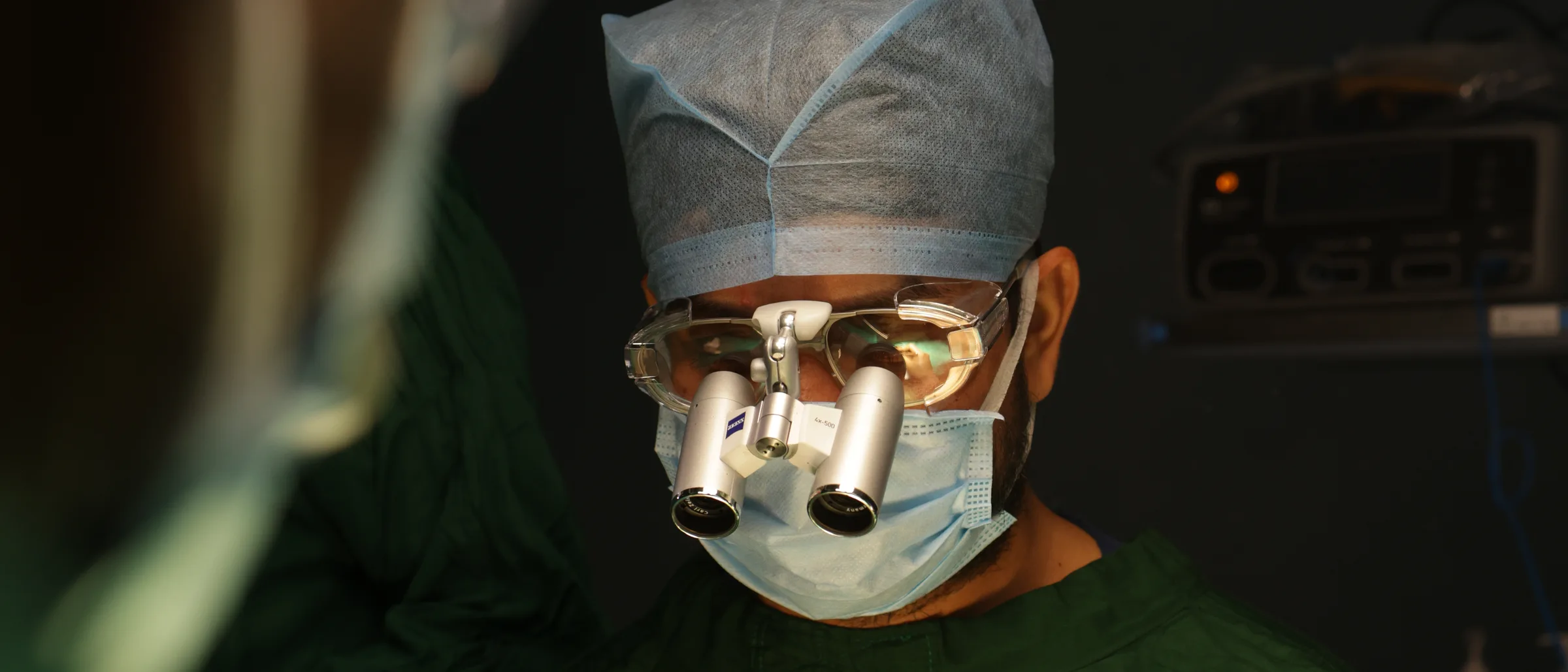
The equipment for this operation is ordinary in the sense that it is the same everywhere it is done well: magnification, fine instruments, fine suture, and a team that is used to working together for a long day. Where a microscope is used it is. What actually decides how a free flap goes is not a machine at all. It is the planning that happens before the day, the decision about which donor site suits your defect, the patience of the joining, and then the hourly watching afterwards — which is nursing work, not equipment. That is why the monitoring after surgery is described on this page in as much detail as the operation. Scans and pathology are arranged for you, with reports back in 24 to 48 hours, and your films and reports belong to you: ask for them, keep them together, and bring them to every appointment. If a hospital tells you about a machine, the more useful questions are who will be watching your flap at three in the morning, and what happens if it changes colour.
Questions we hear every week
Is this a transplant? Are you taking tissue from somebody else?
Can the flap fail?
What will my face look like afterwards?
What happens to my arm or my leg?
Why not just stitch the gap closed and have a shorter operation?
Have a report or a symptom you are unsure about?
Bring it in. If it is nothing, we will tell you it is nothing.
Medically reviewed by The surgical oncology team, Saurashtra Cancer Care, MCh / DNB Surgical Oncology · August 2026