Head and neck cancer
Cancers of the throat, the salivary glands, and the nose and sinuses — next to the mouth, but treated as their own group.
What it is
Head and neck cancer is a group rather than a single disease. It covers the throat behind the mouth and above the food pipe, the salivary glands in front of and below the ear and under the jaw, and the nose and the sinuses around it. As in the mouth, tobacco in any form and alcohol are the common causes here. Some throat cancers are linked to HPV infection rather than to tobacco, and those behave differently, which is one reason the tissue is tested before any treatment is planned. The mouth, the voice box and the thyroid are in the same region and have pages of their own.

Worth getting checked
Any of these is worth an appointment if it has lasted longer than two weeks:
- A lump in the neck that does not go away, even if it does not hurt
- A sore throat on one side that does not settle
- Pain or difficulty swallowing, or food catching in the throat
- A blocked nose on one side only, or bleeding from one side of the nose
- A swelling in front of or below the ear, or under the jaw — sometimes with weakness on that side of the face
- Ear pain on one side when the ear itself looks normal
Most neck lumps and most sore throats are infections, not cancer. Finding out takes one appointment.
How we find out
- A clinical examination.
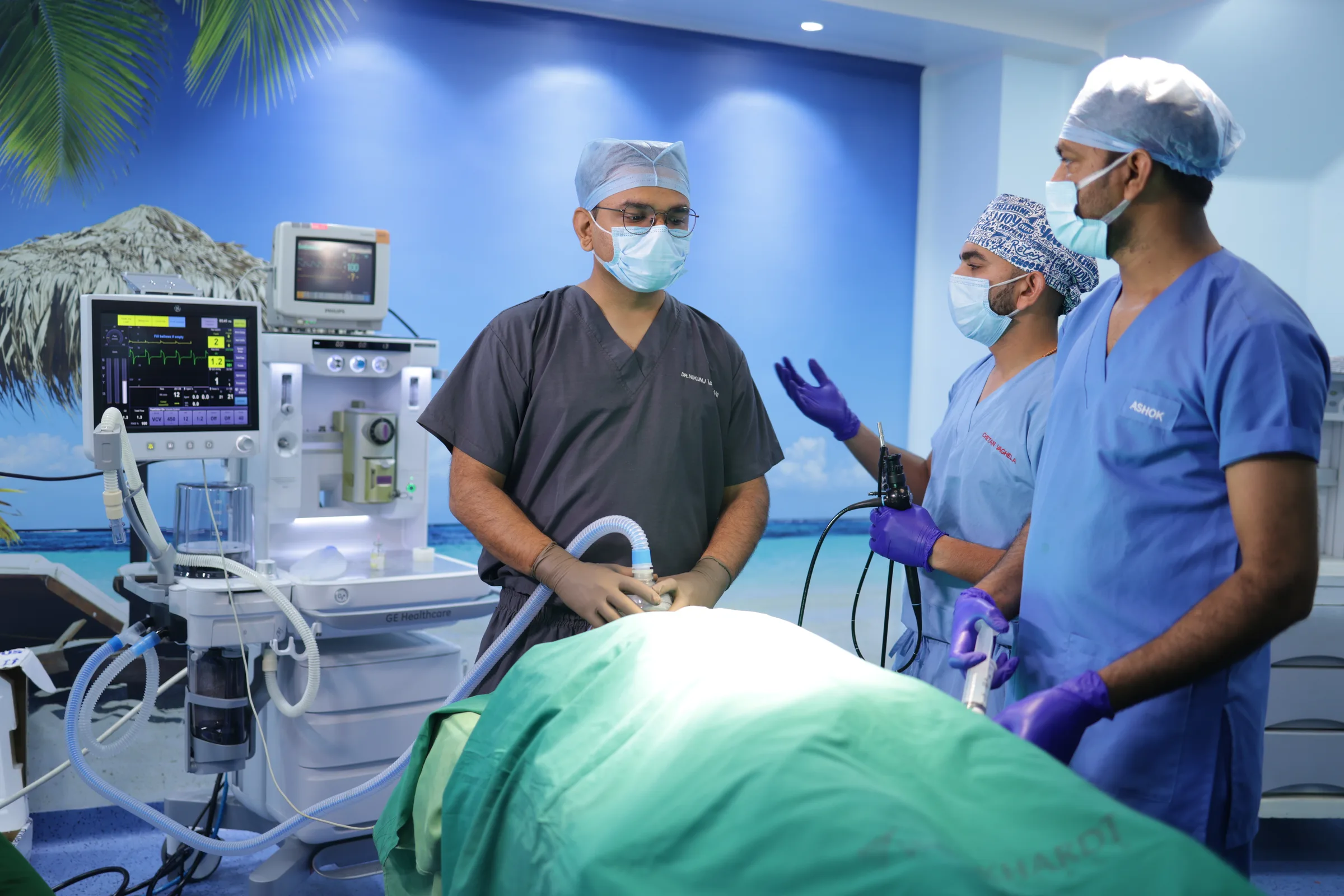
The doctor looks at the mouth and throat and feels the neck. The parts of the throat a torch cannot reach are seen with a thin flexible camera passed through the nose — a numbing spray first, you stay awake, and it takes about a minute.
- A needle test, or a biopsy.
For a lump in the neck, a fine needle draws out cells. For a growth in the throat, a small piece of tissue is taken instead. Either way, this is the only way to be certain. three to five working days for the report.
- Scans, if the test is positive.
A CT, MRI or PET scan shows the size and whether it has spread. This determines the stage, which determines the treatment.
How it is treated here
- Surgery.
- Removing the tumour, and often the lymph nodes on that side of the neck. Where the operation leaves a gap, reconstruction is planned in the same sitting.
- Radiation therapy.
- Using a Varian Halcyon linear accelerator, targeted to spare the salivary glands and the swallowing muscles nearby wherever that is possible.
- Chemotherapy.
- Sometimes alongside radiation, sometimes before surgery to shrink a tumour.
- Targeted and immunotherapy.
- For specific cases, decided by tumour characteristics.
Your combination is decided by the tumour board, not by one doctor alone.
What day-to-day life looks like
Honest expectations: swallowing is usually the part that gets harder, and a dry mouth is common after radiation to this area. Speech and swallowing take deliberate work to recover, and that work starts from the start, and your weight is watched carefully through treatment — losing weight quickly makes everything else harder. Most patients continue living at home and come in for sessions. Recovery needs support as well as an operation — with eating, with speech, with movement, and with getting back to ordinary days. Ask your surgeon what yours will need and who can help with it. If you use tobacco, stopping now measurably improves how treatment works — we have a cessation counsellor and it is free.
Questions we hear every week
I have a lump in my neck. Does that mean cancer?
Why does the doctor want to pass a camera through my nose?
Does a needle test spread cancer?
Can it be treated without surgery?
Will my swallowing go back to normal?
Have a report or a symptom you are unsure about?
Bring it in. If it is nothing, we will tell you it is nothing.
Medically reviewed by The surgical oncology team, Saurashtra Cancer Care, MCh / DNB Surgical Oncology · August 2026