Breast cancer
One of the most common cancers we treat. Most breast lumps are not cancer, and finding out is a short set of tests.
What it is
Breast cancer starts in the breast — most often in the ducts that carry milk towards the nipple, sometimes in the lobules that make it. From there it can travel to the lymph nodes in the armpit, which is why the armpit is examined and scanned along with the breast. The causes that are known are largely not anyone's doing: age, breast or ovarian cancer in the family, and an inherited change in a gene such as BRCA — and in many people no cause is ever identified. Men have breast tissue too and can get breast cancer, though it is much less common. Before any treatment is planned the tissue itself is tested, and what that testing shows is what decides which treatments belong in the plan. It is the reason no two plans on this page look the same.
Worth getting checked
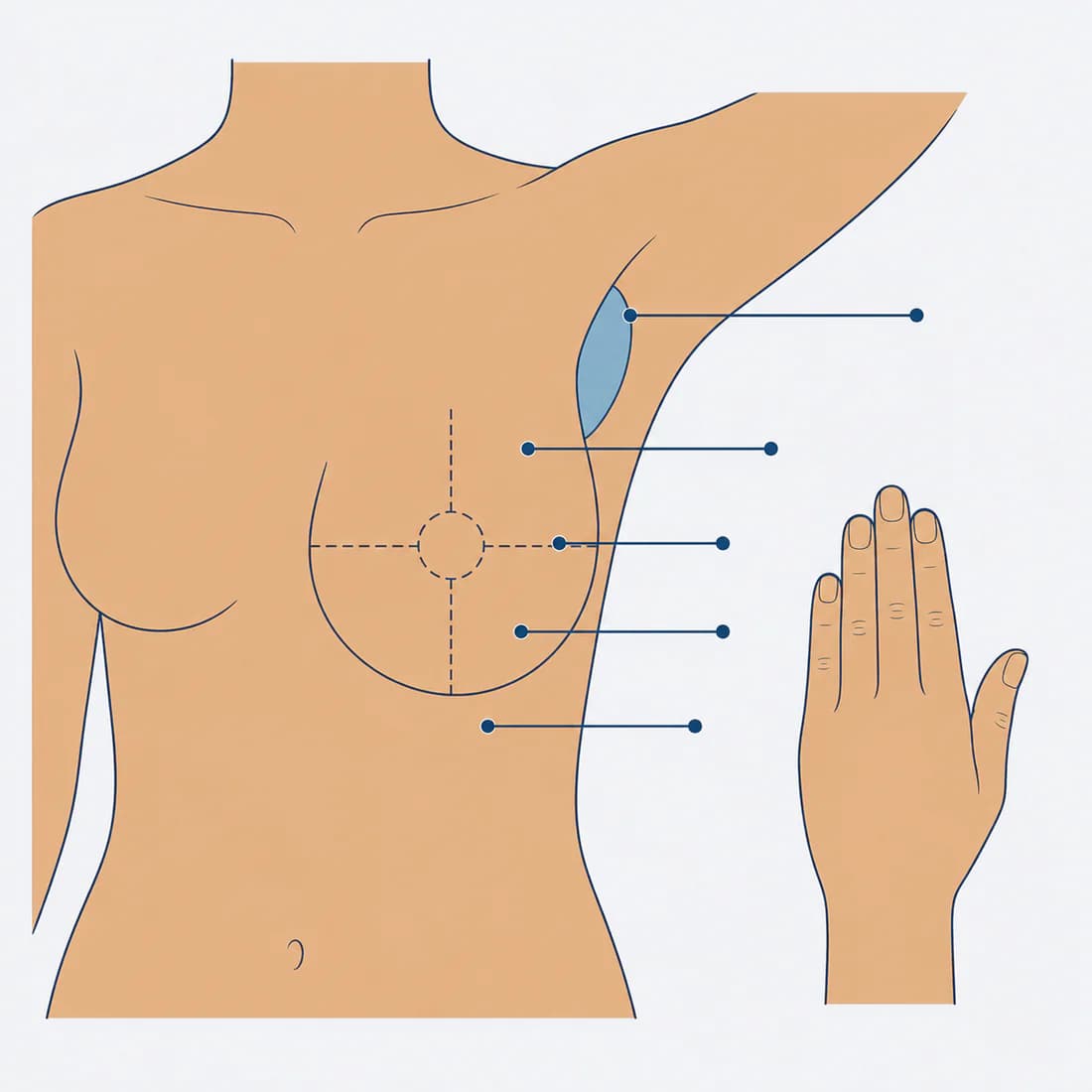
A doctor should look at any of these if they last longer than two weeks:
- A lump or a thickened area in the breast, whether or not it hurts
- A lump or swelling in the armpit, or just above the collarbone
- A change in the size or the shape of one breast
- Skin that dimples, puckers, or looks like the peel of an orange
- A nipple that has turned inward, or skin around it that is red, scaly, or does not heal
- Fluid from one nipple, particularly if it comes without squeezing or is blood-stained
- Pain in one spot in the breast that does not settle
Most breast lumps turn out not to be cancer. That is not a reason to leave one alone — it is a reason not to spend weeks afraid before you know. Usually one appointment and one scan answer it.
How we find out
- A clinical examination.
The doctor examines both breasts and both armpits, and asks how long the change has been there and whether it varies with your monthly cycle. This visit also decides which scan is the useful one for you.
- A mammogram, an ultrasound, or both.
A mammogram is an X-ray of the breast; for each picture the breast is pressed flat between two plates for a few seconds, which is uncomfortable rather than painful. An ultrasound uses sound instead of X-rays and involves no pressing. In younger women the breast tissue is denser and an ultrasound often shows more, so it is common for the ultrasound to be done first, or for both to be done.
- A core-needle biopsy.
A needle a little thicker than the one used for a blood test takes one or two small cores of tissue from the lump, usually with the ultrasound guiding it. Local anaesthetic is given first. This is the only way to be certain, and it is also where the tissue for the tests below comes from. three to five working days for the report.
- Tests on the tissue itself.
The same sample is tested for hormone receptors — oestrogen and progesterone — and for HER2, a protein that some breast cancers carry. These are not a detail on the report: they are what decides whether hormone tablets are part of your treatment, and whether HER2-directed drugs are. They are also why the report takes longer than a simple yes or no.
- Scans, if the biopsy is positive.
A CT, PET or bone scan is done where it is needed, to show whether it has spread. This determines the stage, which determines the treatment.
How it is treated here
- Surgery to the breast.
- Either the lump is removed with a margin of normal tissue around it and the rest of the breast is kept — breast-conserving surgery — or the whole breast is removed, which is a mastectomy. Which of the two is possible depends on the size and position of the tumour, how far it extends inside the breast, and the size of the breast itself. Where both are genuinely possible, that choice is made with you rather than for you.
- Surgery to the lymph nodes in the armpit.
- The armpit is dealt with in every case, because whether the nodes are involved changes the rest of the plan. Where the nodes look clear beforehand, the first node or two that the breast drains into can be found and removed for testing instead of clearing the whole armpit. Where the nodes are already involved, more of them are removed. This is the part of the operation that affects arm and shoulder movement afterwards.
- Radiation therapy.
- Given using a Varian Halcyon linear accelerator. After breast-conserving surgery it is usually part of the plan, as a course of short daily sessions over some weeks. It is also given after a mastectomy in some cases, decided by what the operation and the pathology report show.
- Chemotherapy.
- Not everyone needs it. It is given before surgery in some cases to shrink a tumour, and after surgery in others. Whether it belongs in your plan is decided from the size, the grade, whether the lymph nodes are involved, and the hormone-receptor and HER2 results — not from the diagnosis alone.
- Hormone therapy, and HER2-directed treatment.
- If the tumour carries hormone receptors, a tablet taken every day is usually part of the plan — commonly for at least 5 years, and longer in some cases. It works by keeping the cancer from the hormone it uses. If the tumour carries HER2, drugs directed at HER2 are given over a defined course, usually alongside chemotherapy.
Your combination is decided by the tumour board, not by one doctor alone.
What day-to-day life looks like
Honest expectations: after surgery to the armpit the shoulder is stiff and sore for a while, and the exercises you are given for it matter more than they look like they do — start them on the day you are told to, and keep going after the soreness has settled. If the arm on that side ever swells, tell your doctor, even years later. Tiredness from chemotherapy builds up over the cycles rather than arriving on the first day, and it lifts over the weeks after the course ends. Hair loss is common with the chemotherapy drugs used for breast cancer, and hair grows back once the course is over — sometimes a different texture at first. Radiation makes the skin over the treated area red and tender, like sunburn, and that settles too. And the part people do not expect: if hormone tablets are part of your plan, they carry on for years after everything visible has finished — long after the scans and the sessions have stopped, that one tablet a day is still the treatment. Most patients continue living at home and come in for sessions. Recovery needs support as well as an operation — with eating, with speech, with movement, and with getting back to ordinary days. Ask your surgeon what yours will need and who can help with it.
Questions we hear every week
Does a biopsy spread cancer?
Will I lose my breast?
Does everyone with breast cancer need chemotherapy?
Is breast cancer inherited?
Can I keep working through treatment?
Have a report or a symptom you are unsure about?
Bring it in. If it is nothing, we will tell you it is nothing.
Medically reviewed by The surgical oncology team, Saurashtra Cancer Care, MCh / DNB Surgical Oncology · August 2026