Lung cancer
A cough that has not settled is the usual reason people come in, and most of the time it turns out to be something else.
What it is
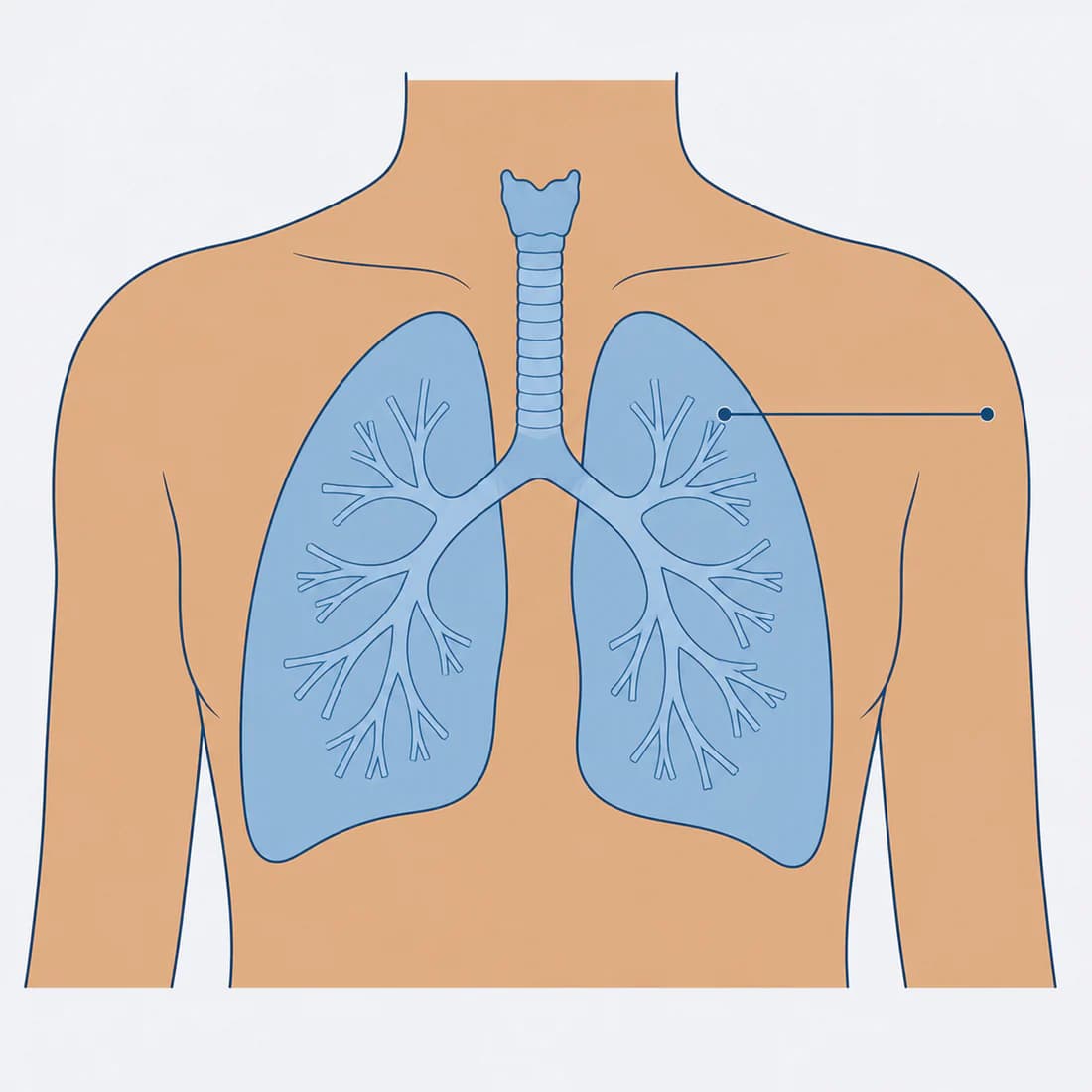
Lung cancer starts in the airways that carry air into the lungs, or in the lung tissue around them. It is divided into two groups, and you will hear both names: non-small cell lung cancer, which is most cases, and small cell lung cancer, which is less common, grows faster, and is usually treated with medicines and radiation rather than with an operation. Smoking tobacco in any form — cigarettes or bidi — is the most common cause in this region, and some people who have never smoked in their lives get lung cancer as well. Long exposure to smoke, dust or fumes also adds to the risk, at work or from a cooking fire at home. How it started does not change the treatment you are offered here.
Worth getting checked
A doctor should look at any of these if they last longer than two weeks:
- A cough that has not settled in two weeks
- A change in a cough you have had for years — more of it, a different sound, or pain with it
- Blood in the phlegm
- Getting short of breath doing something that never used to be a problem
- Chest or shoulder pain that keeps coming back
- A hoarse voice that does not settle
- Chest infections that keep returning
- Losing weight without trying, or losing your appetite
Most of these turn out to be an infection or another lung condition. In this region, tuberculosis and long-standing bronchitis are far commoner causes of a cough that will not settle than cancer is. Finding out takes one appointment.
How we find out
- A chest X-ray.
The first test, and usually the same day. It is quick and inexpensive, and it shows whether anything further is needed. An X-ray that looks normal does not settle the question on its own, which is why a CT often follows it.
- A CT scan of the chest.
This shows the size of the growth, exactly where it sits, and whether the lymph nodes in the centre of the chest look involved. Much of what the surgeon and the radiation doctor need to plan comes from this one scan.
- A biopsy.
Nothing is called cancer until a piece of tissue has been looked at under a microscope. How that piece is taken depends on where the growth is: a bronchoscopy — a thin camera passed down the windpipe — reaches growths in the larger airways, and a growth nearer the outer edge of the lung is reached with a fine needle passed through the chest wall while a CT shows the way. Where lymph nodes in the centre of the chest also need sampling, that is done through the same route with an ultrasound-tipped scope, which you may hear called EBUS. three to five working days for the report.
- Testing the tissue.
The same piece of tissue is tested for particular changes in the tumour — EGFR and ALK are the two names you are most likely to hear — because where one of those is found, a tablet becomes one of the options. This testing is done in a laboratory, and your doctor will tell you where your sample goes and how long the result takes.
- PET/CT, and sometimes a scan of the brain.
A PET/CT looks at the whole body in one sitting and shows whether anything has spread beyond the chest. A CT or MRI of the brain is added in some cases, because the brain is a place lung cancer can reach before it causes any symptom there.
How it is treated here
- Surgery.
- Removing the part of the lung the cancer sits in — a segment, a lobe, or in some cases the whole lung on that side — along with the lymph nodes nearby. It is an option when the cancer is confined to one area and when the lung you would be left with can do the work. That second question is why you are asked to blow into a machine before an operation is decided: a lung function test measures how much air you can move and how well your lungs pass oxygen into the blood.
- Radiation therapy.
- Using a Varian Halcyon linear accelerator, aimed at the growth while sparing the healthy lung around it as far as possible. For someone whose lungs or general health do not allow an operation, radiation can be the main treatment rather than an addition to one. It is also used after surgery in some cases, and on its own to settle pain or bleeding.
- Chemotherapy.
- Given as a course of cycles, with rest between them. It is used before surgery to shrink a tumour, after surgery, or alongside radiation. For small cell lung cancer, chemotherapy with radiation is usually the main treatment rather than an operation.
- Targeted tablets.
- Where the tissue test finds a change such as EGFR or ALK, there are tablets that act on that specific change. They are taken at home, they are not chemotherapy, and their side effects are different. They are an option only where the test finds the change, which is the reason the tissue is tested before treatment is planned.
- Immunotherapy.
- Medicines that work through your own immune system rather than on the tumour directly. Whether they fit your case is decided on the tumour's characteristics, from a further test on the same tissue.
Which combination fits you depends on the type — small cell or non-small cell — the stage, and how well your lungs and the rest of you are working. It is decided by the tumour board, not by one doctor alone.
What day-to-day life looks like
Honest expectations: breathlessness is usually the part people find hardest, and more can be done about it than most people expect — sitting upright and leaning forward, a fan or an open window on your face, pacing a task instead of rushing it, and medicines where those are not enough. Say when it changes rather than waiting for the next appointment. Tiredness builds through a course of treatment and is not something you have to push through. Appetite often drops and weight goes with it, so your weight is checked at every visit; small frequent meals are easier than three large ones, and losing weight quickly makes everything else harder. After chest surgery you are taught breathing exercises and asked to do them through the day — they are what keeps the lung expanded and keeps infection out, and they matter more than they look. Some people need oxygen at home for a period; that is arranged and explained before you go home, and it is a support, not a verdict. Most patients continue living at home and come in for sessions. Recovery needs support as well as an operation — with eating, with speech, with movement, and with getting back to ordinary days. Ask your surgeon what yours will need and who can help with it. If you smoke, stopping now measurably improves how treatment works, during treatment as much as before it — we have a cessation counsellor and it is free.
Questions we hear every week
I smoked. Is this my fault?
Can I still have surgery if I am already short of breath?
Why do I need so many scans?
Does everyone with lung cancer get chemotherapy?
Is it worth stopping smoking now, after the diagnosis?
Have a report or a symptom you are unsure about?
Bring it in. If it is nothing, we will tell you it is nothing.
Medically reviewed by The surgical oncology team, Saurashtra Cancer Care, MCh / DNB Surgical Oncology · August 2026