Diagnostics and staging
The tests that name the disease precisely, because treatment cannot be planned without that.
What it is
Before anyone can tell you what treatment you need, two questions have to be answered: what exactly is this, and how far has it gone. Diagnosis answers the first. Staging answers the second. A stage is not a mark out of four for how serious your situation is, and it is not a prediction — it is a description. It says how big the tumour is, whether it has reached the lymph nodes beside it, and whether it has travelled anywhere further. Doctors write that description in three letters, TNM: T for the tumour itself, N for the nodes, M for anywhere beyond them. Those three together give the stage, and the stage is what decides which treatment is offered to you. That is why the tests come before the plan and not after it.
What happens, step by step
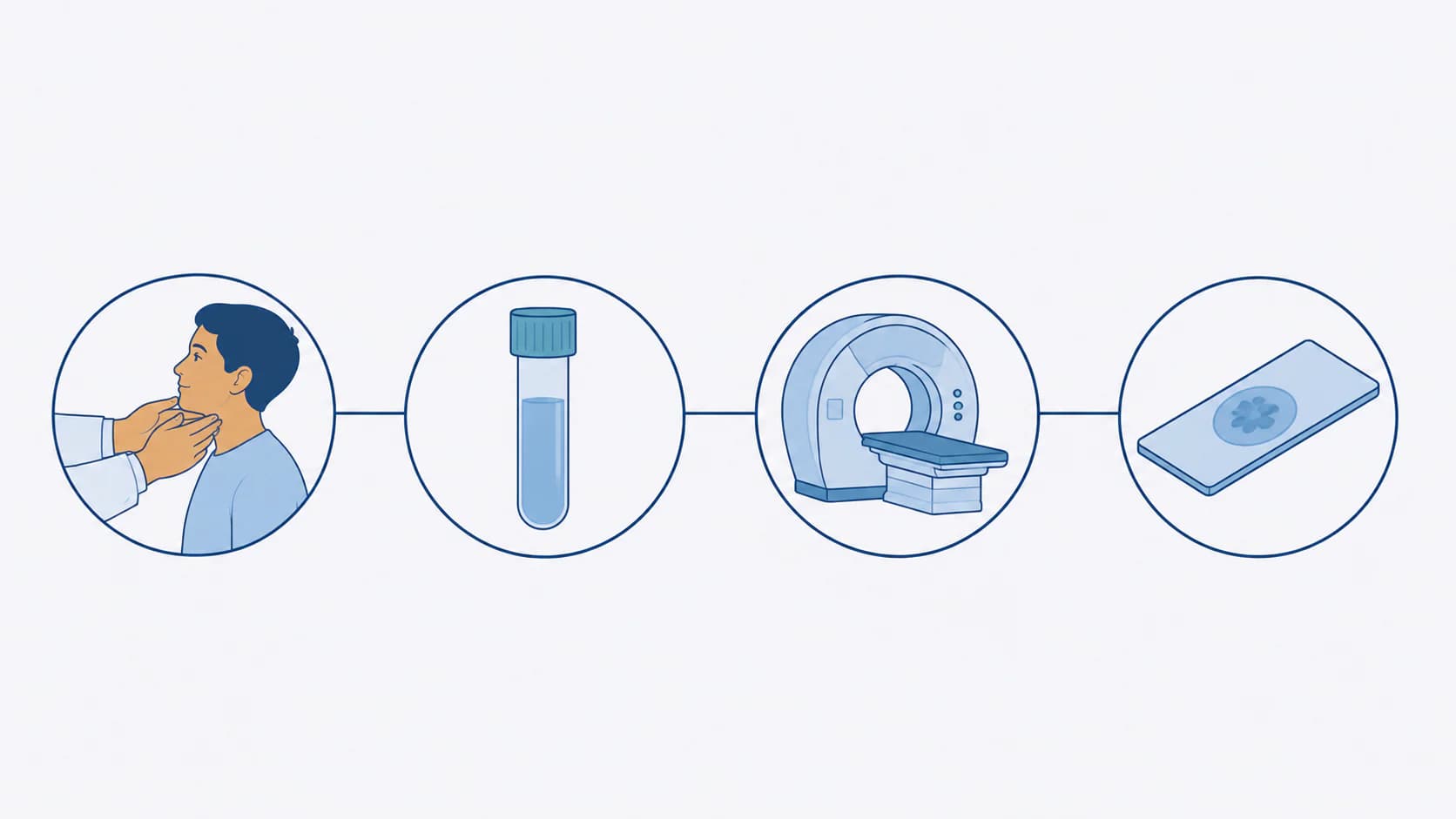
- The consultation, and an examination.
The doctor listens to the whole history first, then looks and feels. Where a torch cannot reach — the back of the throat, the voice box — a thin flexible camera is passed through the nose after a numbing spray; you stay awake and it takes a minute or two. Bring every report and scan you already have, including old ones. They often decide which tests you do not need.
- The test that takes tissue: a biopsy, or a needle test.
A scan can show that something is there. Only tissue can say what it is. Either a small piece of the lump is taken (a biopsy) or a fine needle draws out a few cells (FNAC), and the sample goes under a microscope. Most of these are done with local anaesthetic, without admission, and often with an ultrasound guiding the needle to the right spot. Somewhere hard to reach, such as the voice box, it is done in theatre under a short general anaesthetic instead.
- Imaging, to see how far it has spread.
Depending on the site, this may be an ultrasound, a CT, an MRI, a PET, or some combination. An ultrasound is painless and uses no radiation. A CT is quick and often needs contrast dye through a vein. An MRI takes longer, is noisy, and shows soft tissue in more detail. A PET looks at the whole body in one go. Not everybody needs all of these — the scan is chosen for the question that still needs answering.
- Blood tests.
Blood tests do not diagnose cancer. They show your haemoglobin and how your kidneys and liver are working, and that is what tells us which treatments would be safe for your body. Some cancers do have a marker that can be measured in blood, but a normal blood report does not rule cancer out, and an abnormal one does not confirm it.
- The pathology report.
The tissue goes to a laboratory. It is fixed in chemical, set into a block, cut into slices thinner than a hair, stained, and only then read by a pathologist. The report says not only whether it is cancer but which type it is, and treatment depends on that. Sometimes further tests are run on the same sample to name the type exactly.
- The tumour board.
Before your treatment begins, your case is reviewed by our tumour board — the practice's surgical oncologists together, with the same scans and the same pathology report in front of all of them. They agree one plan rather than each giving an opinion in turn. The board can only do that once every report is in hand, which is one of the reasons the tests are allowed to finish first.
- The plan, explained to you.
You are told your diagnosis and your stage, what the options are, what each one involves, how long it takes and what it will cost — before anything starts. Ask us to repeat anything that did not land the first time, and bring someone with you to hear it too.
How long, and how often
A full workup is normally spread across several days and more than one visit. That is its ordinary shape, not a delay. The consultation and examination happen on the day you come. The biopsy or needle test is often the same day or within a few days of it. Scans are booked separately, sometimes for different days, because some need preparation and the machine is shared with everyone else being scanned that week. three to five working days is the usual wait for a biopsy report, and 24 to 48 hours for reports generally. The reason it is not ready the same afternoon is that tissue has to be processed before anybody can look at it — fixed, set in a block, sliced, stained, then read — and each of those steps takes the time it takes. If a further test on the same sample is needed to name the type exactly, that adds days again. It is also common for one more test to be added once the first result is back; that is the workup doing its job, not starting over. Your case then goes to the tumour board, which sits on a set day of the week. Add all of that together and a week or so between the first appointment and a settled plan is ordinary. This waiting is the hardest part of everything on this page, and we will not pretend otherwise — but a wait of days here is normal, and it is not the same thing as being forgotten. Very few cancers need treatment tomorrow, and a plan built on half the information is the more serious risk. If you have heard nothing by the date you were given, call and ask. Where your report has reached is something you are entitled to know.
Side effects, and the support that comes with them
None of these tests is an operation, and most people go home the same day. A needle test takes a few minutes: local anaesthetic first, then a sting and a feeling of pressure rather than pain, and the spot is sore for a day or two afterwards — an ordinary paracetamol is usually all it needs, and a small bruise is common. A biopsy that takes a larger piece is the same idea with a stitch or two. One done under a short general anaesthetic means a few hours of observation and often a sore throat that evening. For a scan with contrast, a cannula goes into a vein in the back of the hand or the arm; the sharp part lasts seconds. The dye itself causes a warm flush moving through the body, sometimes a metallic taste, and sometimes the feeling that you have passed urine when you have not — all three are expected and pass within a minute. Tell the staff beforehand about kidney trouble, asthma, diabetes medicine, or any previous reaction to a dye. Some scans need you to fast for a few hours; you will be told which, and from when. Take your usual medicines with a sip of water unless you are told otherwise. Lying still is what people find hardest: an MRI is a narrow tube, it is noisy, and it can run twenty minutes or more, so say beforehand if closed spaces are difficult for you, because it can be planned around. A PET is an injection followed by about an hour of sitting quietly while it spreads, and then the scan, so keep the whole morning free. Bring somebody with you if you can — not because these tests are dangerous, but because waiting alone is harder than waiting with company.
What we use
These are standard tests, done in much the same way everywhere: a needle, a slide under a microscope, a scanner, and somebody who reads these every week. What changes the answer is not the badge on the machine — it is whether the right test was chosen for your question, and whether the report was read by somebody who reads these every week. Where imaging is needed we use Varian Halcyon linear accelerator and CT, with CT simulation for planning, and reports come back in 24 to 48 hours. Scans and laboratory work are arranged for you, and you will be told where you are going and why before you go. Your films, slides and reports belong to you: ask for them back, keep them together, and bring them to every appointment. If you have already had a scan or a biopsy somewhere else, bring that too. A test occasionally has to be repeated, and if so you will be told the reason — but often it does not, and nobody should pay twice for the same picture.
Questions we hear every week
The scan already showed it. Why do I still need a biopsy?
Does a biopsy spread cancer?
Why is it taking so long?
Can I eat before a scan?
Why has another test been added after the first one?
Have a report or a symptom you are unsure about?
Bring it in. If it is nothing, we will tell you it is nothing.
Medically reviewed by The surgical oncology team, Saurashtra Cancer Care, MCh / DNB Surgical Oncology · August 2026