Gastrointestinal cancer
Cancers of the digestive tract — the food pipe, the stomach, the liver, the pancreas, the gall bladder and the bowel. One team treats the whole tract, and each part of it behaves differently.
What it is
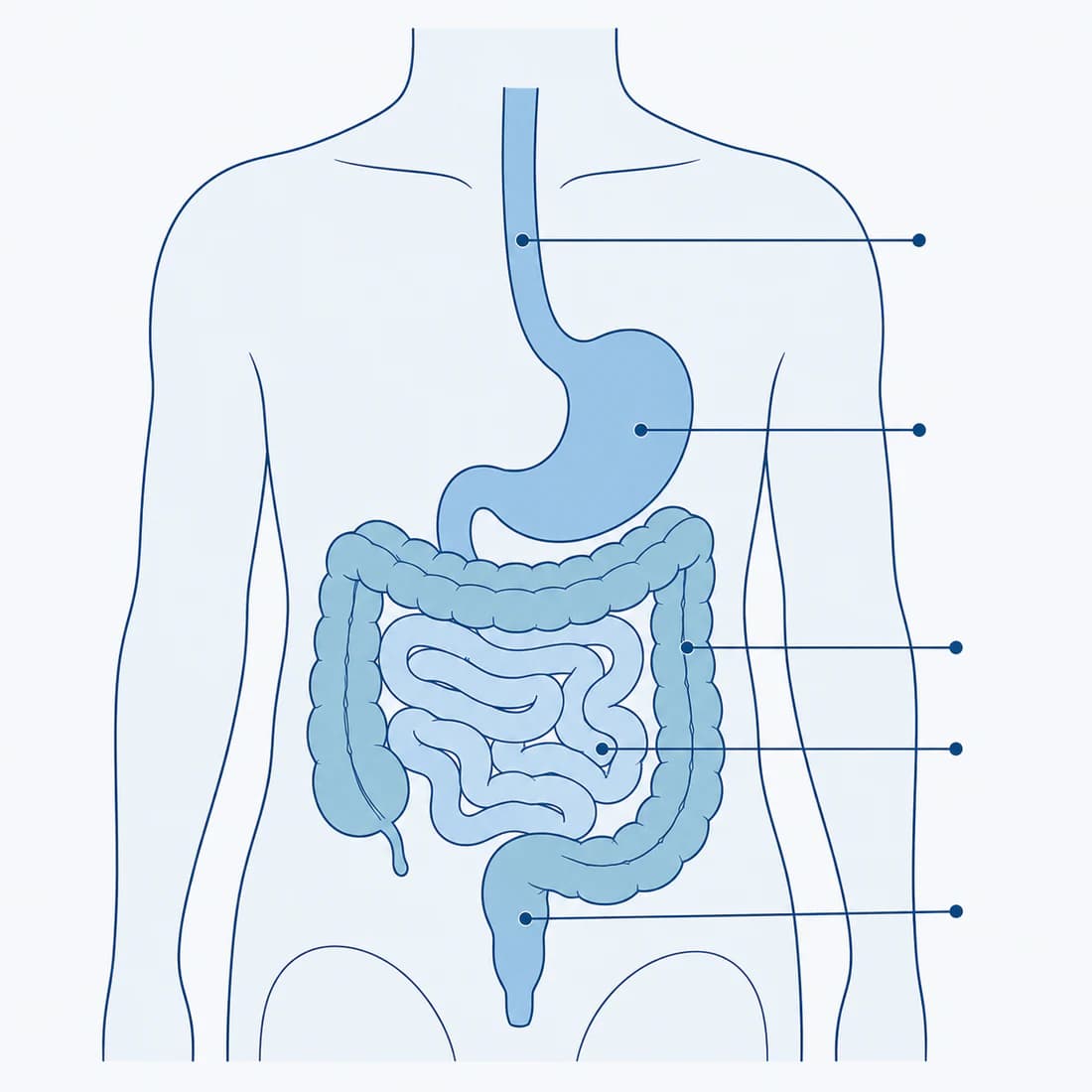
Gastrointestinal cancer is not one disease. It is the name for cancers that begin anywhere along the digestive tract: the oesophagus (the food pipe), the stomach, the liver, the pancreas, the gall bladder, the small bowel, and the colon and rectum. They sit on one page because one surgical team operates on the whole digestive tract, and because the tests that reach it are shared. They are not one condition. A cancer of the food pipe and a cancer of the rectum lie in the same tract, but they cause different symptoms, they are treated in a different order, and what your doctor says about one will often not be true of the other. What follows describes what these cancers have in common; your own plan will be about the one organ involved.
Worth getting checked
A doctor should look at any of these if they last longer than two weeks:
- Difficulty swallowing, or food catching on the way down
- Indigestion, or pain after eating, that has not settled
- A change in bowel habit — looser, harder, or more often than is usual for you
- Blood in the stool, or stools that are black
- Losing weight without trying to
- Yellowing of the eyes or the skin
- Vomiting that keeps coming back
- Feeling full soon after starting to eat
Most of these turn out to be an ulcer, an infection, piles, or another common condition of the digestive tract. Finding out takes one appointment.
How we find out
- An endoscopy — a camera that looks inside.
A thin flexible camera is passed through the mouth to see the food pipe, the stomach and the first part of the small bowel. The throat is numbed with a spray, and sedation is offered so that it is comfortable. It takes a few minutes and does not need an overnight stay.
- A colonoscopy, for the lower bowel.
The same kind of camera, passed through the back passage, to see the colon and the rectum. The bowel has to be empty first, so you are given a preparation to take at home the day before — that part is the inconvenient part, not the test itself. When to have a colonoscopy if you have no symptoms is a decision for your own doctor, who knows your history and your family history.
- A biopsy, taken during the same test.
If anything is seen, a small piece of tissue is taken through the same camera, then and there. It is not painful, and it does not mean another appointment. three to five working days for the report.
- Scans, and blood tests.
A CT of the abdomen and chest shows the size of the tumour and whether it has spread; this is what sets the stage. An ultrasound is often the first scan done for the liver and the gall bladder. An MRI is used for cancers of the rectum and of the liver, where it shows the soft tissue more clearly than a CT does. A PET scan is used where the other scans leave a question. Blood tests are taken alongside, including liver function tests.
How it is treated here
- Surgery.
- The affected part of the digestive tract is removed along with the lymph nodes around it, and the two ends are joined back together. How large an operation that is depends on which organ is involved.
- Keyhole (laparoscopic) surgery, where it suits the case.
- Instead of one long cut, the operation is done through several small ones with a camera. Minimal access and laparoscopic cancer surgery is a stated area of work of one of our surgical leads, so where it suits the case it is done here. Whether it suits yours depends on which organ is involved, where the tumour sits, how far it has grown, and what abdominal operations you have had before. That is decided before the day of surgery, and discussed with you.
- Chemotherapy.
- Sometimes before surgery, sometimes after, and sometimes both. Before surgery it is given to shrink the tumour and make the operation a cleaner one; after surgery it is given to treat cells that may have travelled beyond what was removed. Which way round it goes depends on the organ and on the stage, and it is settled before anything starts rather than as you go along.
- Radiation therapy.
- Used mainly for cancers of the rectum and of the food pipe, where it is often given together with chemotherapy before surgery. Delivered with a Varian Halcyon linear accelerator, targeted to spare the healthy tissue around it.
- A stoma, in some operations.
- A stoma is an opening made on the abdomen through which the bowel empties into a bag worn on the skin. It is needed when a join in the bowel needs time to heal, or when the rectum itself has had to be removed. Often it is temporary — the join heals over some weeks or months, and the stoma is closed at a second, smaller operation. Sometimes it is permanent. Either way it is discussed with you before the operation rather than after it, and you are taught to look after it before you go home.
Which of these you have, and in what order, is decided by the tumour board, not by one doctor alone.
What day-to-day life looks like
Honest expectations: eating is the part of this that takes the most attention. Most people manage better on smaller meals more often than on three large ones, and on food that is soft and goes down easily. If swallowing is hard, soft food and liquids that carry some nourishment are better than quietly eating less — tell your doctor early, because there are ways to help, and losing weight quickly makes every other part of treatment harder. That is why your weight is checked at each visit. After surgery on the rectum the bowel behaves differently for a while: going more often, going more urgently, or going several times close together is common in the first months, and for most people it settles as the bowel adjusts. Tiredness through chemotherapy is ordinary and is not a sign that something has gone wrong. If you have a stoma, how to manage it — the bag, the skin around it, and what to do if something does not look right — is taught to you before you go home, not left for you to work out afterwards. Most patients continue living at home and come in for sessions. Recovery needs support as well as an operation — with eating, with speech, with movement, and with getting back to ordinary days. Ask your surgeon what yours will need and who can help with it.
Questions we hear every week
Will I need a stoma, and is it forever?
I have already had a CT scan. Why do I need a scope as well?
Can this be done by keyhole surgery?
Will I be able to eat normally afterwards?
Does everyone need chemotherapy?
Have a report or a symptom you are unsure about?
Bring it in. If it is nothing, we will tell you it is nothing.
Medically reviewed by The surgical oncology team, Saurashtra Cancer Care, MCh / DNB Surgical Oncology · August 2026