Oral cancer
The most common cancer we treat in Saurashtra, and one of the most treatable when it is found early.
What it is
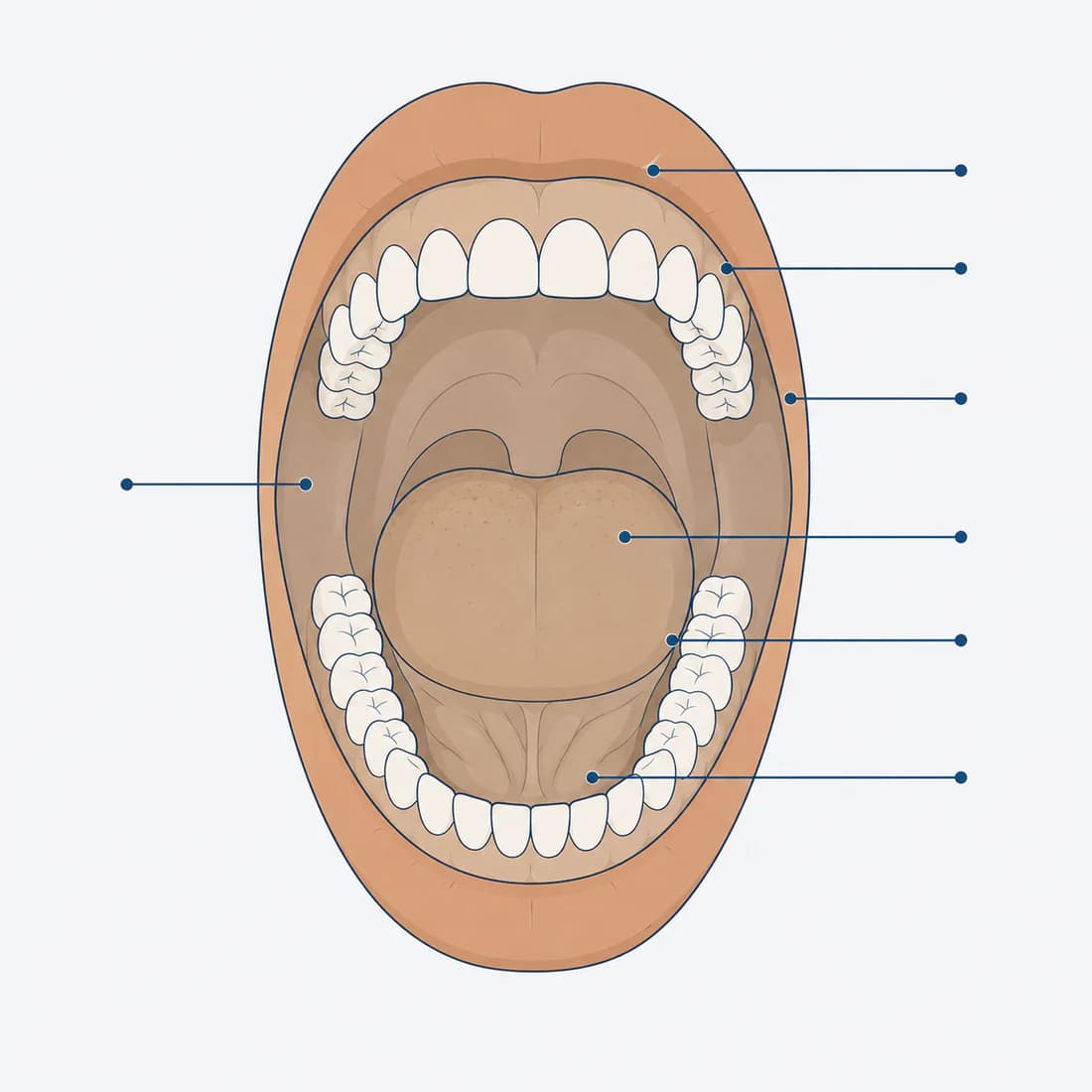
Oral cancer starts in the mouth: the tongue, the inner cheek, the gums, the floor of the mouth, the palate, or the lips. In this region, the most common cause is long-term use of tobacco in any form — cigarettes, bidi, mawa, gutkha, pan masala or supari. Alcohol adds to the risk. The throat, the voice box and the thyroid sit immediately alongside the mouth and are treated by the same team; each has a page of its own.
Worth getting checked
A doctor should look at any of these if they last longer than two weeks:
- An ulcer or sore in the mouth that does not heal
- A white or red patch on the tongue, gums or inner cheek
- A lump in the mouth, neck, or under the jaw
- Difficulty opening the mouth fully, or a burning feeling with spicy food
- Pain or difficulty while swallowing
- A tooth that becomes loose for no clear reason
- Bleeding in the mouth with no clear cause, or numbness in the lip or tongue
Most of these turn out not to be cancer. Finding out takes one appointment.
How we find out
- A clinical examination.
The doctor looks and feels. Often this is enough to know whether anything further is needed. Takes minutes.
- A biopsy.
A small piece of tissue is taken and examined under a microscope. This is the only way to be certain. It is done with local anaesthetic. three to five working days for the report.
- Scans, if a biopsy is positive.
A CT, MRI or PET scan shows the size and whether it has spread. This determines the stage, which determines the treatment.
How it is treated here
- Surgery.
- Removing the tumour, and sometimes lymph nodes in the neck. Reconstruction is planned at the same time where needed.
- Radiation therapy.
- Using a Varian Halcyon linear accelerator, targeted to protect healthy tissue nearby.
- Chemotherapy.
- Sometimes before surgery to shrink a tumour, sometimes alongside radiation.
- Targeted and immunotherapy.
- For specific cases, decided by tumour characteristics.
Your combination is decided by the tumour board, not by one doctor alone.
What day-to-day life looks like
Honest expectations: eating and speaking can become difficult for a period; speech and swallowing take deliberate work to recover, and that work starts early rather than after everything else is finished. Most patients continue living at home and come in for sessions. Recovery needs support as well as an operation — with eating, with speech, with movement, and with getting back to ordinary days. Ask your surgeon what yours will need and who can help with it. If you use tobacco, stopping now measurably improves how treatment works — we have a cessation counsellor and it is free.
Questions we hear every week
Is a mouth ulcer always cancer?
Does a biopsy spread cancer?
Can it be treated without surgery?
Will I be able to speak and eat normally?
I stopped tobacco years ago. Am I still at risk?
Have a report or a symptom you are unsure about?
Bring it in. If it is nothing, we will tell you it is nothing.
Medically reviewed by The surgical oncology team, Saurashtra Cancer Care, MCh / DNB Surgical Oncology · August 2026