Prostate and urological cancer
Cancers of the prostate, bladder, kidney and testis — found in different ways, and treated by one surgical team.
What it is
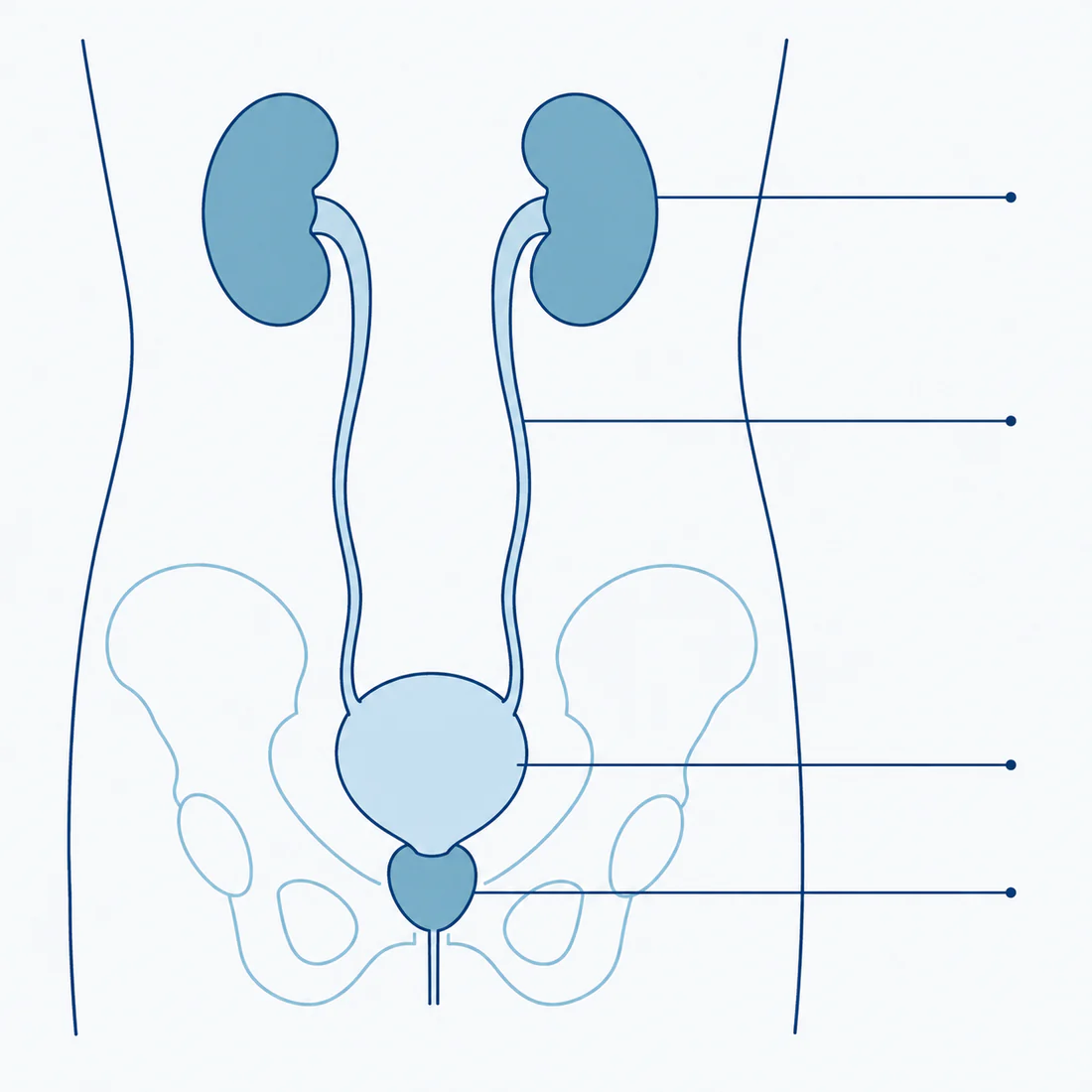
This page covers four cancers of the urinary tract and the male reproductive organs: the prostate, the bladder, the kidney and the testis. They are grouped together because one surgical team treats the urinary tract from the kidney down — not because they are one disease. They behave differently, they are found in different ways, and they are treated differently. The prostate is a small gland sitting below the bladder; it grows larger in most men with age, and that enlargement is common and is not cancer. Bladder and kidney cancers are linked to long-term smoking. Cancer of the testis is uncommon, and unlike the other three it usually appears in younger men.
Worth getting checked
A doctor should look at any of these if they last longer than two weeks. Blood in the urine is the exception: that is worth an appointment the first time it happens.
- Passing urine more often than you used to, or getting up at night to pass it
- A weak or interrupted stream, or difficulty starting
- Blood in the urine — even once, even if it does not hurt, and even if it does not come back
- Pain in the back or the hips that does not settle
- A lump, a swelling, or a heavy feeling in one testis
- A dull ache in one side of the lower back with no other explanation
- Losing weight without trying to
Most urinary symptoms in older men turn out to be benign enlargement of the prostate — very common with age, and not cancer. Finding out takes one appointment.
How we find out
- A clinical examination.
The doctor asks about your urinary symptoms and examines the abdomen. For the prostate this includes a brief examination through the back passage with a gloved finger. It takes less than a minute, it is uncomfortable rather than painful, and it tells the doctor the size, the shape and the feel of the gland — which no blood test can. For a lump in the testis, the doctor examines it directly.
- A PSA blood test.
PSA is a protein made by the prostate, measured in an ordinary blood sample. A raised level can come from cancer, but it also rises with an enlarged prostate, with a urine infection, and after a catheter or a recent procedure. Whether to have the test at all is a decision for you and your own doctor, and it is worth talking through before the blood is taken rather than after the result arrives.
- An ultrasound.
A painless scan. Of the kidneys and the bladder when there is blood in the urine or a change in passing it, and of the scrotum when there is a lump in a testis. No needle, no radiation.
- A cystoscopy, for blood in the urine.
A thin telescope is passed along the urinary passage so the lining of the bladder can be looked at directly, usually with local anaesthetic gel. It is the most direct way to find out where blood in the urine is coming from.
- An MRI of the prostate, and then a biopsy if it is needed.
An MRI is done before any prostate biopsy rather than after it. It shows whether there is an area worth sampling and exactly where it is, and in some men it shows that no biopsy is needed. A biopsy takes small pieces of tissue and examines them under a microscope; this is the only way to be certain. three to five working days for the report. A lump in the testis is the exception — it is not sampled with a needle. The diagnosis is made from the testis once it has been removed, and your surgeon will explain why before you consent.
- A CT, and a bone scan where it is needed.
A CT shows the kidneys, the bladder and the lymph nodes around them, and whether anything has spread. A bone scan is added when the doctor needs to know whether the bones are involved. Together these determine the stage, which determines the treatment.
How it is treated here
- Active surveillance.
- For some slow-growing prostate cancers the plan is to monitor carefully rather than to operate or irradiate straight away. This is a treatment decision, not a refusal to treat, and it is not the same as doing nothing: it means PSA tests at set intervals, examinations, and a repeat scan or a repeat biopsy on a schedule you are given in writing. If anything changes, the plan changes with it, and surgery and radiation are still open to you then. It is offered because in these cancers the difficulties treatment brings can outweigh what treatment adds — and that judgement is made from your biopsy and your scans, not in general.
- Surgery to remove the prostate.
- The whole gland is removed, along with lymph nodes in the pelvis in some cases. What the operation involves, and what it can affect — urinary control and erections in particular — is gone through with you by your surgeon before you consent.
- Radiation therapy.
- Using a Varian Halcyon linear accelerator, given as a course of short daily sessions over several weeks. For many prostate cancers surgery and radiation are both reasonable, and that choice is made with you rather than for you.
- Hormone therapy.
- Prostate cancer cells grow in response to testosterone, the male hormone. Hormone therapy — injections, tablets, or both — lowers testosterone or blocks its effect, which slows the cancer down. It is given alongside radiation in some cases, and on its own when the cancer has spread beyond the prostate. It is not chemotherapy, and the two are often confused.
- Surgery for a kidney cancer.
- Removing the kidney, or only the part of it holding the tumour where that is possible. One healthy kidney does the work of two, so people live ordinary lives after a kidney is removed.
- Bladder tumour surgery.
- A bladder growth is usually removed through a telescope passed along the urinary passage, with no cut on the abdomen — and the tissue for the report is taken in the same sitting. What that report shows decides what follows: treatment given directly into the bladder in some cases, and removal of the bladder in others. This telescope operation is not a TURP, which is done to relieve the blockage caused by an enlarged prostate; the two names are close and are often confused.
- Treatment for testicular cancer.
- The affected testis is removed through a small cut in the groin — an orchidectomy — and this both makes the diagnosis and is the first part of the treatment. Chemotherapy follows in many cases, decided by what the tissue shows and by blood markers. The other testis is left alone.
Your combination is decided by the tumour board, not by one doctor alone.
What day-to-day life looks like
Honest expectations — and this page will be direct about the two things men most often do not ask about. Urinary control: after the prostate is removed most men leak urine at first. That is expected rather than a complication, and it improves over weeks to months; pads are used in the early period. Pelvic floor exercises strengthen the muscle that holds urine in, and doing them properly and daily is the part of recovery that is in your own hands — your surgeon will show you how, and will tell you whether to start before the operation. Sexual function: surgery and radiation to the prostate can both affect erections, sometimes for a period and sometimes lastingly, because the nerves involved run along the outside of the gland. Ask your surgeon what is likely in your case before you consent, and ask again afterwards — there are treatments for erection difficulty, and there is no reason to sit with it in silence. After the prostate is removed ejaculation changes, though the sensation of orgasm usually does not go away. On hormone therapy, expect tiredness, hot flushes, and less interest in sex; those are effects of the treatment rather than of age, and your doctor can help with some of them. For a young man with testicular cancer, storing a sperm sample is discussed before treatment starts, because it can only be done first — say so if you may want children later, even if you are not sure. Most patients continue living at home and come in for sessions. Recovery needs support as well as an operation — with eating, with speech, with movement, and with getting back to ordinary days. Ask your surgeon what yours will need and who can help with it.
Questions we hear every week
My PSA is raised. Does that mean I have cancer?
Will I be incontinent after the operation?
Will treatment affect my sex life?
Why would a doctor suggest not treating it?
Do I really need a rectal examination?
Have a report or a symptom you are unsure about?
Bring it in. If it is nothing, we will tell you it is nothing.
Medically reviewed by The surgical oncology team, Saurashtra Cancer Care, MCh / DNB Surgical Oncology · August 2026