Cervical and gynaecological cancer
Cancers of the cervix, the uterus and the ovaries — three different diseases, grouped here because one team cares for all three.
What it is
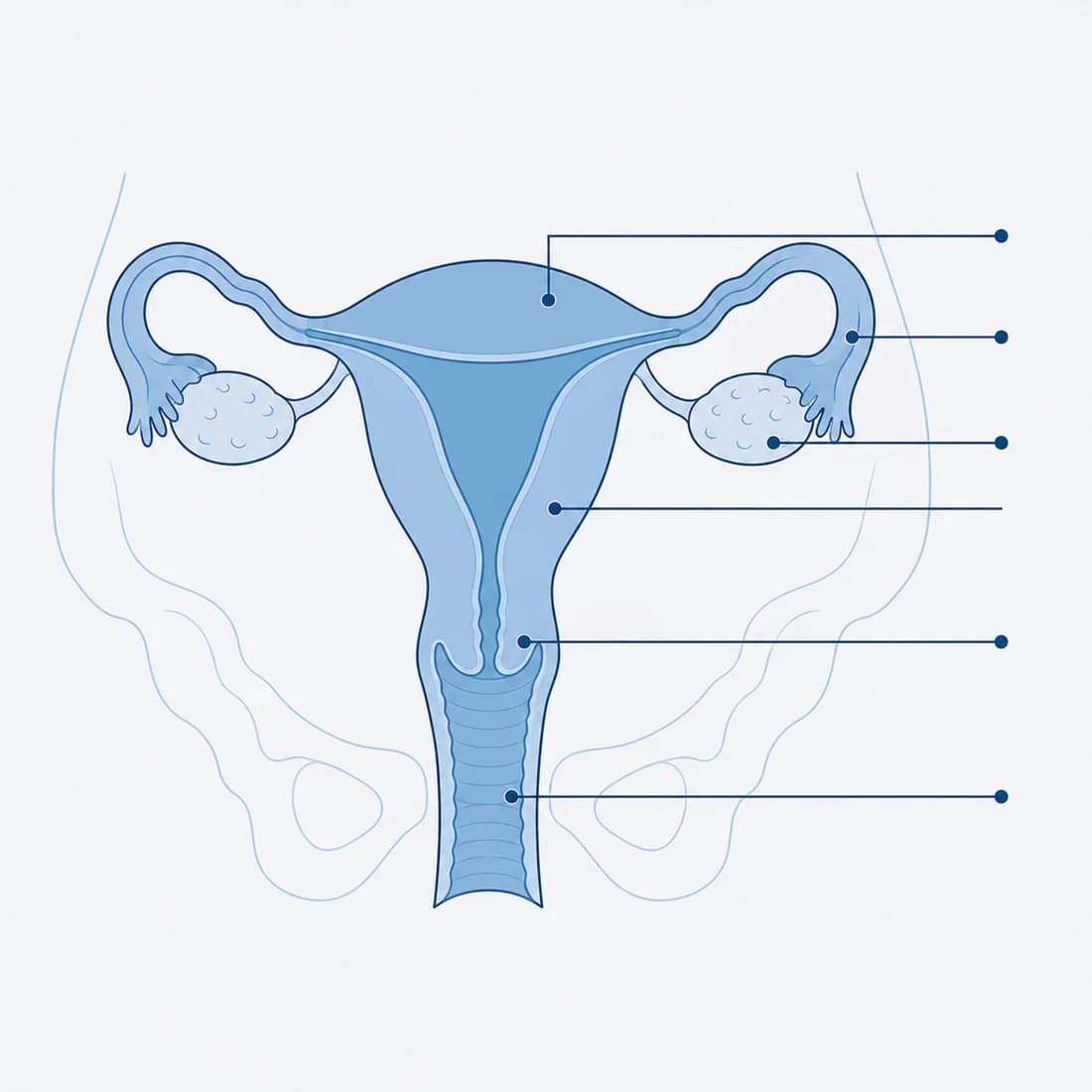
This page covers three cancers that are grouped together because one team treats them, not because they are the same disease. The cervix is the lower part of the uterus, where it meets the top of the vagina. The uterus above it is lined by the endometrium, and cancer of the uterus almost always begins in that lining. The two ovaries sit on either side, deep in the pelvis. Cancer of the cervix nearly always follows a long-standing infection with HPV — a common virus passed on through sexual contact, which most people who come into contact with it clear on their own without ever knowing they had it, and which in a small number of women stays for years and slowly changes the cells of the cervix. That is a statement about how this cancer starts and nothing more: it is not a judgement about a woman or her marriage, and it is not evidence of anything either husband or wife did. Cancer of the uterus is linked instead to the body's own hormones, and bleeding after the menopause is usually what brings it to a doctor. Cancer of the ovary has no single common cause; increasing age, and cancer of the ovary or the breast in the family, are the risks that are known.
Worth getting checked
A doctor should look at any of these if they last longer than two weeks. Bleeding after the menopause is the one exception: a single episode is reason enough for an appointment.
- Bleeding between periods, or bleeding after intercourse
- Any bleeding at all after the menopause, however little
- Periods that have become much heavier or much longer than they used to be
- A discharge that is new, heavy, blood-stained or has a smell
- Pain low in the abdomen or the pelvis, or pain during intercourse
- Bloating that stays, or feeling full after eating very little
- Passing urine more often than usual when no infection is found
Most of these turn out to have another cause — an infection, fibroids, or an ordinary change in hormones around this time of life. Bloating and pelvic discomfort in particular are vague, and they almost always mean something other than cancer. Finding out takes one appointment.
How we find out
- An examination.
The doctor asks about your periods and your bleeding, then examines the abdomen and the pelvis. Seeing the cervix needs a speculum, a small instrument that holds the walls of the vagina apart for a few seconds, and an internal examination with a gloved hand follows. It is uncomfortable rather than painful and it takes a few minutes. You may bring your husband, your mother, your daughter, your sister or a friend into the room with you, and you may ask for a female member of staff to be present while it is done. You may ask for either at any point — at the door, in the room, or after the examination has already started — and you may ask for it to stop.
- A Pap smear, and an HPV test.
A Pap smear takes a small brush of cells from the surface of the cervix, and those cells are examined under a microscope for changes. An HPV test looks at the same kind of sample for the virus itself. Neither is a test for cancer as such: both look for the infection and the cell changes that come long before it, at a stage that can be watched or treated. Whether you should have these tests, and how often, is a decision for your own doctor, and it depends on your age, your history and what earlier tests have shown. Ask that at your appointment rather than following an interval you read somewhere.
- Colposcopy, and a biopsy.
If a smear shows changes, the cervix is looked at through a colposcope — a magnifying light that stays outside the body — and a small piece of tissue is taken. Where the concern is the uterus, a sample is taken from its lining instead, either in the clinic or under a short anaesthetic. Either way the biopsy is the only thing that settles the question. three to five working days for the report.
- An ultrasound.
An ultrasound of the pelvis shows the thickness of the lining of the uterus and the size and character of the ovaries. It is often done with a slim probe passed into the vagina rather than over the abdomen, because from there it is closer and shows more. It uses no radiation and no needle. For the ovaries this is usually the first test there is.
- Scans, if a biopsy is positive.
A CT, MRI or PET scan shows the size and whether it has spread. This determines the stage, which determines the treatment. For the ovary a blood test called CA-125 is often added, though it rises for harmless reasons too and is never read on its own.
How it is treated here
- Surgery.
- How much is removed depends on which organ is involved and how far the cancer has gone. For a small cancer of the cervix it can mean removing a cone of the cervix itself and nothing more. More often it means a hysterectomy — removing the uterus together with the cervix — sometimes with the tubes and ovaries, and often with lymph nodes from the pelvis. For cancer of the ovary the operation is usually the more extensive one, and its aim is to remove all the disease that can be seen. Whether your ovaries can be left is a separate question from whether your uterus can, and it is worth asking before the operation is planned rather than afterwards.
- Radiation therapy.
- For cancer of the cervix, radiation given together with chemotherapy is frequently the main treatment rather than an addition to surgery — for many stages the two are alternatives rather than a sequence, and the tumour board chooses between them. Radiation to the cervix is usually given in two parts: a course from outside the body, using a Varian Halcyon linear accelerator, and a shorter treatment with the source placed close to the cervix from inside.. For cancer of the uterus, radiation is more often given after surgery, in the cases where the pathology report advises it.
- Chemotherapy.
- For cancer of the ovary, chemotherapy is a central part of the treatment rather than an addition to it — given before surgery in some cases and after it in others. For cancer of the cervix it is most often given alongside radiation, to make the radiation work better. For cancer of the uterus it is used in certain stages and certain types, decided on what the pathology shows.
- Hormone and targeted treatment.
- Some cancers of the uterus respond to hormone tablets, and some cancers of the ovary are treated with targeted drugs after chemotherapy. Both are decided on tests done on the tumour tissue itself, not on the organ alone.
Your combination is decided by the tumour board, not by one doctor alone. For cancer of the cervix in particular, whether the plan is surgery or radiation with chemotherapy is one of the first questions that board answers.
What day-to-day life looks like
Honest expectations, starting with the questions people most often do not ask out loud. If the uterus is removed, periods stop from that day and pregnancy is no longer possible. If you are young, or if you may want children later, say so before the treatment is planned rather than after — it does not always change what can be done, but it changes what can be considered, and it can only be discussed while there is still a decision to be made. If the ovaries are removed, or if they lie in the area being irradiated, menopause follows soon afterwards, and it arrives all at once rather than gradually: hot flushes, disturbed sleep, dryness and changes in mood are common, there are treatments for them, and it is worth asking, because many women assume this part simply has to be borne. Radiation to the pelvis irritates the bladder and the bowel — passing urine more often, loose motions and soreness are usual during the course and settle over the weeks after it ends. Sex after treatment is an ordinary thing to ask about and a medical question like any other: the vagina can become drier or narrower after pelvic radiation, there are simple things that help, and if it is easier to ask a woman, say so and that can be arranged. Most patients continue living at home and come in for sessions. Recovery needs support as well as an operation — with eating, with speech, with movement, and with getting back to ordinary days. Ask your surgeon what yours will need and who can help with it.
Questions we hear every week
HPV is a sexually transmitted infection. Does that mean my husband did something?
Will I still have periods after treatment?
Can I have children after this?
My uterus has been removed. Does that mean I am cured?
Do I need to bring someone with me for the examination?
Have a report or a symptom you are unsure about?
Bring it in. If it is nothing, we will tell you it is nothing.
Medically reviewed by The surgical oncology team, Saurashtra Cancer Care, MCh / DNB Surgical Oncology · August 2026